Airbnb API vs. Datasets: Kaggle, Inside Airbnb & Limits
Inside Airbnb and Kaggle give you free Airbnb datasets, but they're frozen snapshots. Here's what each contains, how stale it gets, and when a live API wins.
You can get Airbnb data for free from Inside Airbnb or Kaggle. You just can’t get today’s Airbnb data that way.
Free Airbnb datasets are frozen snapshots: accurate on the day they were captured, drifting every day after. A live Airbnb API returns current data on demand. This post covers what the popular datasets contain, how fast they go stale, and when to reach for an API instead.
Where can you download Airbnb datasets?
The two main sources are Inside Airbnb and Kaggle. Inside Airbnb publishes free quarterly CSV snapshots for about 40 cities, with separate files for listings, the availability calendar, and reviews. Kaggle hosts static datasets like the New York City and U.S. Airbnb Open Data, popular for practice and machine learning.
Both are genuinely useful, and both are free.
Inside Airbnb’s files are the richer set. A typical city download gives you listings.csv with price, room type, and host details, calendar.csv with a year of availability, reviews.csv with guest review text, and a neighbourhoods GeoJSON. Kaggle’s sets are usually a single cleaned CSV, easier to load but narrower.

What’s the difference between a dataset and an API?
A dataset is a static file captured on one date; an API is a live service you query on demand. The dataset hands you a frozen copy of a market at a moment in time. The API returns whatever is true right now, for any listing or city you ask about. One is a photograph; the other is a live view.
That single difference drives every trade-off below.

A dataset is instant to load, free, and reproducible, which is why researchers love it. An API costs per call and needs a key, but it never goes stale and isn’t limited to the cities someone chose to capture. You pick based on whether your question is about the past or the present.
How stale does Airbnb dataset data get?
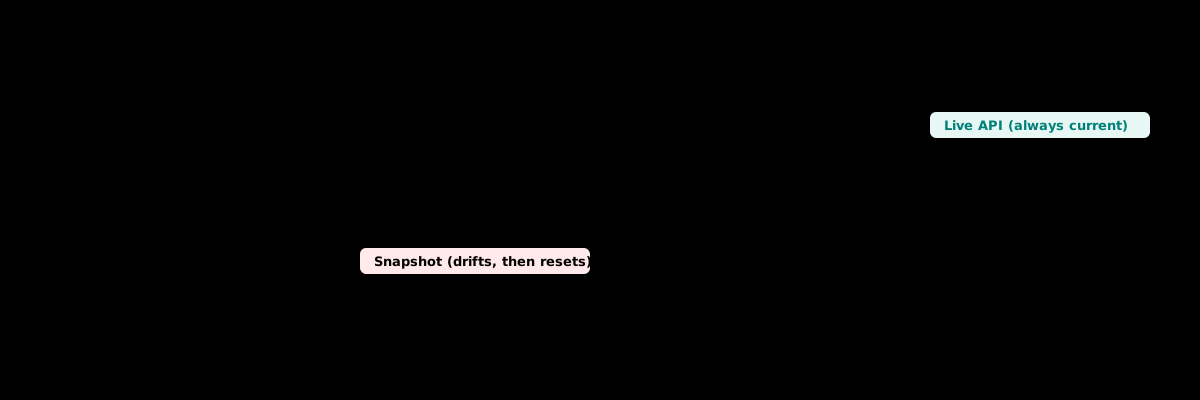
Fast, because prices and availability move constantly. Inside Airbnb refreshes quarterly, so a snapshot is routinely one to three months old when you use it, and older if you pull an archived quarter. Nightly rates shift with seasonality and demand, and calendars change daily, so a three-month-old file can misprice a market by a wide margin.
For historical analysis, that staleness is fine. For anything current, it’s the whole problem.
If you’re studying how Barcelona’s supply grew in 2019, a 2019 snapshot is perfect. If you’re pricing a listing for next weekend or monitoring a market this month, a quarterly file simply can’t answer the question. The data was true once, and “once” isn’t good enough for live decisions.
Dataset vs. API: a side-by-side
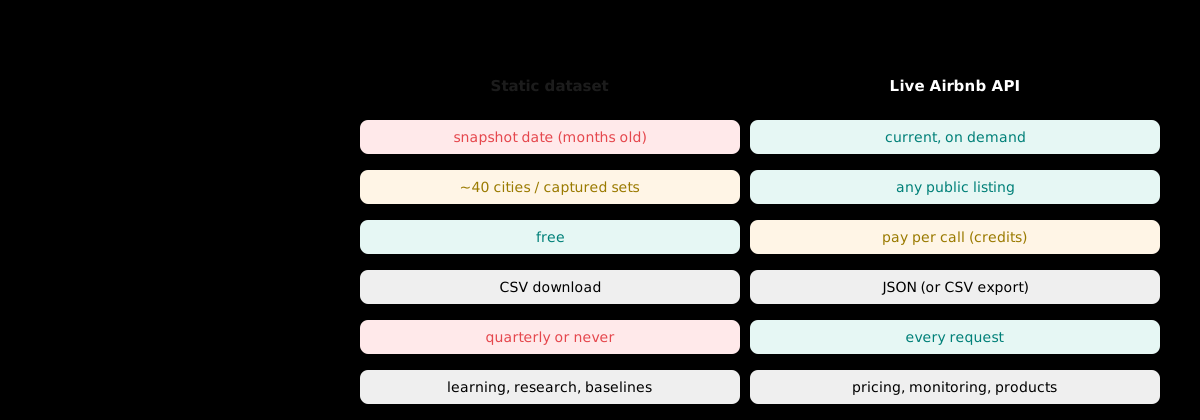
Datasets win on cost and reproducibility; APIs win on freshness and coverage. A snapshot is free and fixed, ideal for learning and repeatable research. An API is metered but live, and reaches any city rather than the roughly 40 Inside Airbnb captures. Here’s the full contrast.
| Static dataset | Live Airbnb API | |
|---|---|---|
| Source | Inside Airbnb, Kaggle | Staying API |
| Freshness | Snapshot date (months old) | Current, on demand |
| Coverage | ~40 cities / captured sets | Any public listing |
| Cost | Free | Pay per call (credits) |
| Format | CSV download | JSON (or CSV export) |
| Updates | Quarterly or never | Every request |
| Best for | Learning, research, baselines | Pricing, monitoring, products |
The pattern is consistent: a dataset is the cheaper, easier choice right up until your decision depends on current numbers. Then the API is the only one that answers.
When should you use each?
Use a dataset when a fixed snapshot is a feature, and an API when it’s a bug. Learning data science, training a model, or publishing reproducible research all call for a stable file everyone can re-download. Live pricing, availability, market monitoring, or a product feature all need current data that a quarterly snapshot can’t provide.
A simple rule sorts most cases:
- Studying the past, or need a fixed baseline anyone can reproduce? Use a dataset.
- Making a decision that depends on today’s prices or availability? Use an API.
- Building a product on top of Airbnb data? Use an API, so your users never see stale numbers.
Plenty of teams start on a free dataset to prototype, then move to an API once the project needs to be current. The migration is easy, since a listing has the same shape whether it came from a CSV row or a JSON response. We compared the live option in depth in does Airbnb have an API and Airbnb API documentation.

Start with a snapshot, ship on live data
Inside Airbnb and Kaggle are excellent for learning and for any question about the past. They cost nothing and they’re reproducible, which is exactly what research wants.
The moment your question becomes “what is this listing doing right now,” a snapshot can’t answer it. Grab a free API key and pull a current listing yourself. 100 credits are enough to see the difference between last quarter’s file and today’s data.
Frequently asked questions
- Where can I download Airbnb datasets?
- The two main sources are Inside Airbnb and Kaggle. Inside Airbnb publishes free quarterly CSV snapshots (listings, calendar, and reviews) for about 40 cities. Kaggle hosts static datasets like the New York City and U.S. Airbnb Open Data. Both are free downloads and great for learning, but they're snapshots, not live feeds.
- Is Inside Airbnb data up to date?
- Only as of its snapshot date. Inside Airbnb refreshes on a quarterly schedule, so a file can be one to three months old when you download it, and older if you grab an archived quarter. Prices and availability drift quickly, so for anything current you need a live Airbnb API rather than a snapshot.
- What is the Kaggle Airbnb dataset?
- It's a collection of static Airbnb datasets hosted on Kaggle, most famously the New York City Airbnb Open Data with around 48,000 listings from 2019. They're popular for learning data science and machine learning because they're clean and free, but they're frozen in time and cover only the cities and dates they were captured.
- Are Airbnb datasets free?
- Yes. Inside Airbnb publishes its data for free under an open license, and Kaggle's Airbnb datasets are free to download. That makes them ideal for practice, research, and reproducible academic work. The cost shows up later, as staleness: a free snapshot that's three months old can misprice a market you're trying to analyze today.
- Should I use a dataset or an API for Airbnb data?
- Use a dataset for learning, reproducible research, or historical baselines, where a fixed snapshot is a feature. Use a live Airbnb API for anything current: pricing, availability, market monitoring, or a product. A dataset answers what a market looked like last quarter; an API answers what it looks like right now.
- How current is Airbnb dataset data?
- A dataset is exactly as current as its capture date and never updates after that. Inside Airbnb's quarterly cadence means months of drift between refreshes. A live API returns today's prices and availability on demand, so if your decision depends on current numbers, the snapshot's age is the deciding factor.
Build it on real Airbnb data
Pull listings, photos, host info, reviews, availability, and pricing from one REST endpoint. 100 free credits, no credit card.