Does Airbnb Have an API? The Complete 2026 Answer
Yes and no. Airbnb has an official Partner API, but it's invite-only. Here's what exists, who can use it, and how to get Airbnb listing data without an invite.
Does Airbnb have an API? Yes. Just probably not the one you came here looking for.
Airbnb runs an official Airbnb API called the Partner API, but it’s invite-only and built for managing your own listings, not reading the public marketplace. If you want listing data — prices, reviews, availability, photos for listings you don’t own — you’ll use a third-party API or a scraper instead. This guide covers every option and the fastest path to actual data.
Does Airbnb have an official API?
Yes. Airbnb has one official API, the Partner API, and it is a closed integration program for vetted property management systems, channel managers, and activity-booking platforms. There is no public developer portal and no self-serve signup. It exists to let approved companies manage listings on behalf of hosts who connect their accounts, governed by Airbnb’s API Terms of Service.
So the honest answer to “does Airbnb have an API” is: one, and you probably can’t get into it.
Airbnb evaluates Partner API applicants on three things: the profitability of your business model, the strength of your technical infrastructure, and your ability to support a shared base of hosts. That’s a high bar, and it’s the bar for the one program that exists.
Even hosts who want to connect their own account run into it. The Airbnb community forums are full of people asking how to enable API access and getting pointed back to approved software partners.
Why can’t most developers get Airbnb API access?
Most developers can’t get Airbnb API access because the Partner program is invite-only and Airbnb approaches partners directly rather than taking applications. There’s no signup form, no API key button, and no documentation you can read without a relationship. As of 2026, the program is effectively closed to unsolicited requests.
This catches a lot of teams off guard.
You sit down expecting a developer portal like Stripe or Twilio. You find a help article and a contact form. The program is built for a few dozen large software platforms, not the thousands of developers who want to pull a listing or two.
If you run a property management system with real volume, it’s worth contacting Airbnb’s partnerships team. For everyone else — analysts, indie developers, AI agent builders, data teams — the official route is a dead end. That’s not a knock on Airbnb. It’s just a different product than the one you need.
What can the official Airbnb API actually do, and not do?
The Partner API manages listings on accounts that authorize your app: syncing calendars, updating pricing, handling messages and reservations for connected hosts. It cannot read the public marketplace. You can’t query “every two-bedroom in Lisbon under $200” or pull a competitor’s reviews. Its scope is the listings you’re authorized to manage, not the ones you want to study.
This is the distinction that trips people up, so it’s worth being blunt about it.
There are two completely different jobs people call “the Airbnb API”:
- Managing your own listings. Calendar sync, pricing updates, reservation handling. This is what the Partner API does.
- Reading listing data you don’t own. Prices, availability, reviews, photos across the public marketplace. This is what most data and analytics work needs.
The official API does the first. It does nothing for the second. If your goal is market research, pricing intelligence, lead enrichment, or feeding an AI agent, the Partner API wouldn’t help you even if you got in.
How do developers get Airbnb listing data without the official API?
Developers get Airbnb listing data three ways: a third-party Airbnb API that returns normalized JSON, a do-it-yourself scraper, or a static dataset like Inside Airbnb. The third-party API is the fastest to production and the lowest to maintain. Scraping gives you control but breaks often. Datasets are free but go stale within months.
Here’s how the three break down in practice.
Third-party Airbnb APIs. You sign up, get a key, and call a REST endpoint that returns clean JSON for any public listing. No proxies, no parsing. AirROI’s review of providers is a decent map of the landscape if you want to compare options.
Scraping it yourself. You can, but Airbnb is genuinely hard to scrape. It runs on React, so a raw request returns an empty HTML shell with no listing data. It sits behind Cloudflare Enterprise bot protection that blocks datacenter IPs before they reach the page. You’ll need headless browsers, a residential proxy pool, and someone to fix the selectors every time Airbnb ships a change.
Static datasets. Projects like Inside Airbnb and Kaggle publish free snapshots. They’re great for learning and academic work, but they’re periodic dumps that can be months old, so they’re a poor fit for live pricing or current availability.

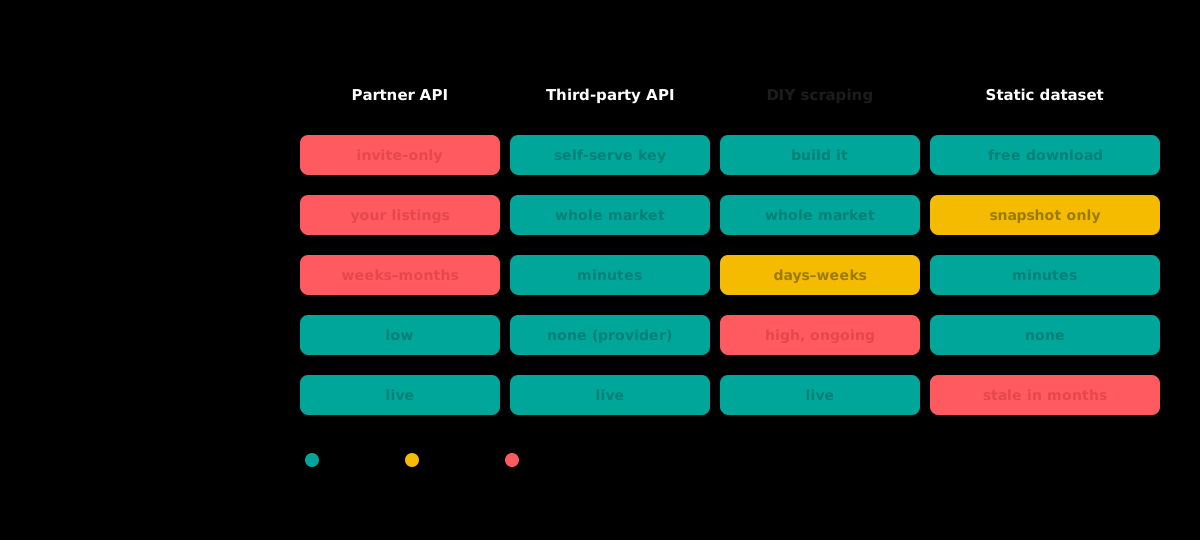
Airbnb API vs scraping vs datasets: which should you use?
Use a third-party Airbnb API when you need current data with little maintenance, a scraper when you need full control and have engineers to babysit it, and a dataset when you need free historical data and freshness doesn’t matter. For most production work — pricing, analytics, agents — a maintained API wins on total cost once you count engineering time.
The trade-off isn’t really about sticker price. It’s about who fixes it when Airbnb changes.
| Official Partner API | Third-party API | DIY scraping | Static dataset | |
|---|---|---|---|---|
| Access | Invite-only | Self-serve key | Build it yourself | Free download |
| Data scope | Your listings | Public marketplace | Public marketplace | Snapshot only |
| Setup time | Weeks to months | Minutes | Days to weeks | Minutes |
| Maintenance | Low | None (provider’s job) | High and ongoing | None |
| Freshness | Live | Live | Live | Stale in months |
| Cost model | Negotiated | Pay per call | Proxies + engineer time | Free |
| Best for | Channel managers | Most data/agent work | Niche custom needs | Research, ML training |
Bright Data, one of the larger scraping vendors, reports a 99% success rate on Airbnb with 48 structured fields per listing at roughly $0.75 per 1,000 successful requests. That’s a fair benchmark for what good scraping costs, before you add the engineer who keeps it running.
A maintained API folds that maintenance into the price. You write one request; the provider absorbs Airbnb’s churn.
How much does an Airbnb data API cost?
Most third-party Airbnb APIs price per call rather than per seat, so cost scales with what you pull. Staying API uses prepaid credits: a single stay lookup is 1 credit, an address resolution is 3 credits, and a search page is 12 credits. You start with 100 free credits, and paid plans run from $5 a month for 400 credits up to a 5,000-credit annual plan.
Credit pricing is easier to forecast than seat licensing because it maps to usage you can actually measure.

The free tier is enough to test against real listings before you commit. Paid plans add throughput on top of credits: the monthly plan allows 200 requests per minute, the annual plan 300, and enterprise goes to 1,500 for high-volume pipelines.

Worth saying plainly: a single listing lookup costing 1 credit means you can pull around 100 listings on the free tier without paying anything. That’s a real test, not a toy demo.
How do you make your first Airbnb API call?
You make your first call by signing up for an API key, then sending an authenticated GET request to a stays endpoint with a listing ID. The response is one canonical Stay object in JSON — no HTML, no headless browser, no selectors. Every stay carries sub-resources for photos, reviews, host, amenities, availability, and pricing that you can request on their own URLs.
Here’s the whole thing with Staying API:
curl https://api.stayingapi.com/v1/stays/1135700964697993602 \ -H "Authorization: Bearer sk_live_..."You get back a predictable shape:
{ "data": { "id": "1135700964697993602", "title": "Beachfront flat in Estoril", "pricing": { "price": 184, "currency": "USD" }, "host": { "is_superhost": true } }, "request_id": "req_..."}Need to find listings instead of looking one up? POST /v1/search takes a location, dates, and filters like price and bedroom count, and hands back a page of matching stays. The quickstart walks through both in about five minutes.
Sub-resources keep responses lean. Ask for /photos or /reviews on their own and you only pay for and transfer what you use, instead of dragging every field along for the ride.

What can you build with an Airbnb API?
Once you can pull listing data on demand, the common builds fall into four buckets: short-term rental analytics, dynamic pricing tools, lead enrichment for travel and real-estate platforms, and AI agents that answer questions about real listings. Each one needs current data on listings you don’t own, which is exactly what the official API won’t give you and a third-party API will.
Analytics is the biggest one. Teams pull occupancy signals, nightly prices, and review counts across a market to track supply, benchmark a portfolio, or underwrite a purchase.
Pricing tools sit on top of that same data. A revenue or pricing calculator is really a model over a comp set: find similar nearby listings, read their prices and availability, and estimate what a unit should charge.
Lead enrichment is quieter but everywhere. A CRM or travel platform takes a listing URL a user pasted and fills in photos, location, and host details automatically, instead of asking the user to type them.
Then there are agents. Because Staying API ships an MCP server, tools like Claude and ChatGPT can call it directly, so an assistant can answer “what’s the nightly rate for this Lisbon listing next July” without you writing glue code. That’s the use case the official Partner API was never built for.
Start with the data, not the gatekeeper
Airbnb has an API. It’s the Partner API, it’s invite-only, and unless you’re a channel manager with real volume, it isn’t the answer to your question.
If what you actually need is listing data — prices, availability, reviews, photos at scale — skip the gatekeeper. Grab an API key, spend your 100 free credits against real listings, and see the JSON for yourself before you write a line of integration code.
Frequently asked questions
- Does Airbnb have a public API?
- No. Airbnb has no general-purpose public API for reading listings, prices, or reviews. Its only official API is the Partner API, an invite-only program for vetted property managers and channel managers. To read public listing data, developers use a third-party Airbnb API or build a scraper.
- Is there a free Airbnb API?
- Airbnb's own API has no free, self-serve tier. Third-party Airbnb APIs do: Staying API gives you 100 free credits on signup with no credit card, which is enough to pull around 100 listings or run a few searches before you pay anything.
- How do I get an Airbnb API key?
- You can't get one from Airbnb unless they invite you into the Partner program. With a third-party provider you sign up, open the dashboard, and generate a key in under a minute. You then pass it as a bearer token on every request. No Airbnb approval is involved.
- Can I use the Airbnb API to get other hosts' listing data?
- Not with the official Partner API. It only manages the listings on accounts that authorize your app. To pull data on listings you don't own (for market research, pricing, or analytics), you need a third-party Airbnb data API or a scraper that reads the public marketplace.
- Is it legal to use a third-party Airbnb API?
- Reputable providers return publicly visible listing data and handle the sourcing and compliance posture for you. Legality depends on your jurisdiction and what you do with the data, so review the terms for your use case. Using public data for analytics is generally lower-risk than collecting personal information.
- What's the difference between the Airbnb Partner API and a third-party Airbnb API?
- The Partner API is Airbnb's official program for managing your own listings, and it's invite-only. A third-party Airbnb API is a self-serve REST service that returns normalized data on the public marketplace. The first manages listings you control; the second reads listings you don't.
Build it on real Airbnb data
Pull listings, photos, host info, reviews, availability, and pricing from one REST endpoint. 100 free credits, no credit card.